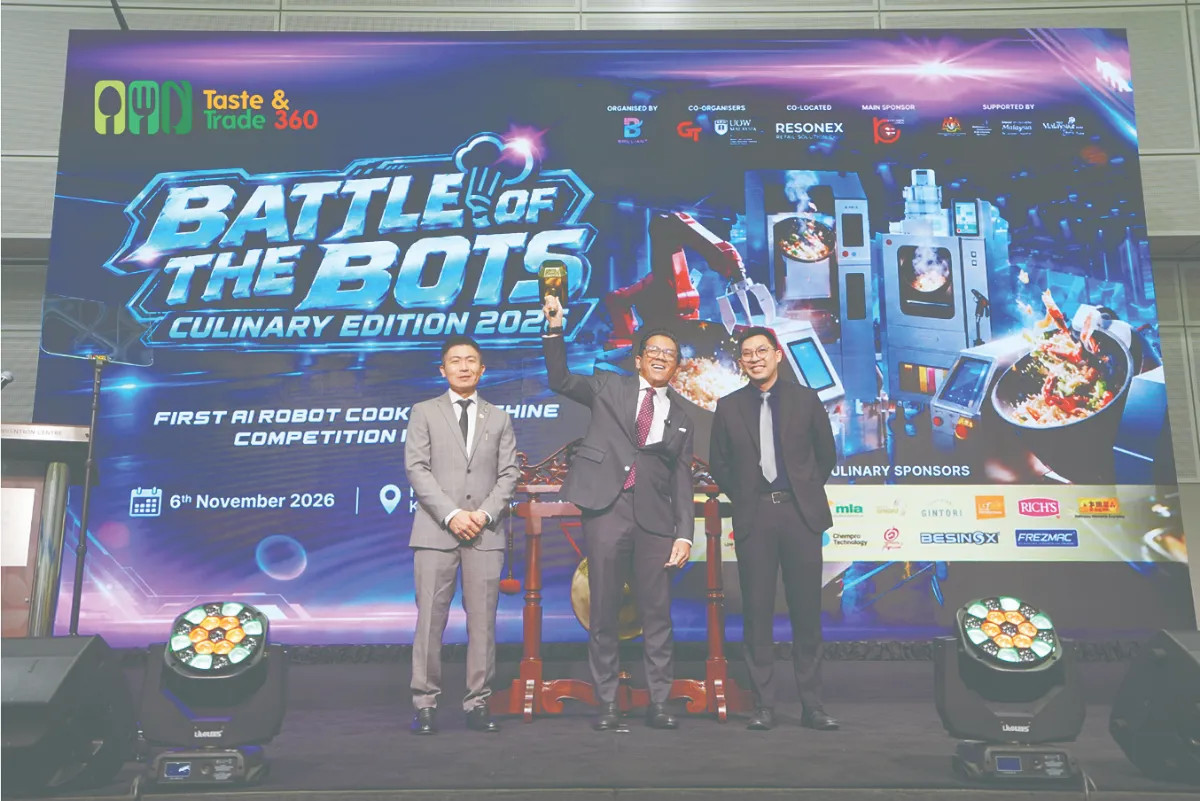
KUALA LUMPUR: Robotic cooking technology could help transform Malaysia’s food and beverage (F&B) industry by improving operational efficiency, food quality and consistency, while creating new opportunities for local technology developers. Deputy Economy Minister Datuk Seri Mohd Shahar Abdullah said artificial intelligence (AI), intelligent cooking robots, and automated systems offer practical solutions to challenges faced by F&B operators, including labour shortages, rising operating costs, and volatile ingredient prices. He said adopting automation was increasingly important as businesses faced growing demands for food hygiene, quality and service efficiency. “Artificial intelligence, intelligent cooking robots and automated systems offer practical, scalable solutions. “By using automated systems, businesses can maintain exact control over cooking temperatures, timings and heat levels, significantly reducing human error and ensuring uniform food quality,” he said at the launch of Battle of the Bots: Culinary Edition 2026, held in conjunction with Taste & Trade 360 (TT360) 2026 on Friday. The competition features 10 robotic cooking machines competing in live cooking challenges, including the Malaysia Local Cuisine Challenge and Creative Dish Challenge, where dishes are assessed based on taste, creativity, complexity and presentation. Mohd Shahar said the technology could also help businesses reduce food waste through more accurate demand forecasting, while allowing kitchen employees to move away from repetitive manual tasks towards higher-value responsibilities such as customer service. He added that Malaysia’s F&B services subsector generated RM83 billion in revenue in 2025, up 10.4% from RM75.2 billion in 2024, according to the Department of Statistics Malaysia. The subsector also recorded more than 858,000 workers at the end of 2025, up 2.5% from approximately 837,000 in 2024. “These figures reinforce the importance of helping operators strengthen their capacity, improve service consistency and manage resources efficiently,” he said. Mohd Shahar said the adoption of robotics and AI also aligned with the government’s broader ambition under the 13th Malaysia Plan (RMK13) and AI Nation 2030 Blueprint to position Malaysia as a creator of home-grown technological solutions rather than merely a technology consumer. He said local businesses and technology developers should work towards producing “Made by Malaysia” robotics and AI solutions that address practical operational challenges. Meanwhile, Gene Tech Sdn Bhd director Brian Ding said the real test of robotic cooking technology was whether machines could deliver consistent quality and efficiency in actual commercial kitchen environments. “The real test of robotic cooking technology is not whether a machine can prepare a dish, but whether it can deliver quality, consistency and efficiency in line with the demands of commercial kitchens. “Through Battle of the Bots, we want to demonstrate that this technology is suitable for real culinary settings, using dishes and cooking requirements familiar to Malaysians,” he said. The competition also showcases X-Bot, a robotic cooking system developed by Gene Tech Sdn Bhd, through an initiative involving Gene Tech, Ping Edge and UOW Malaysia. Mohd Shahar said the technology’s development must also support the wider industrial value chain, including research and development, AI software engineering, sensor manufacturing, equipment design, food logistics, maintenance services and technical training. He stressed that technological advancement in the halal food industry must remain guided by food safety, hygiene and strict compliance with halal requirements.
KleverStock
Robotic cooking technology offers new growth opportunities
Published 08 November 2026, 08:49 pm Updated 08 November 2026, 11:47 pm The Sun · BusinessEN