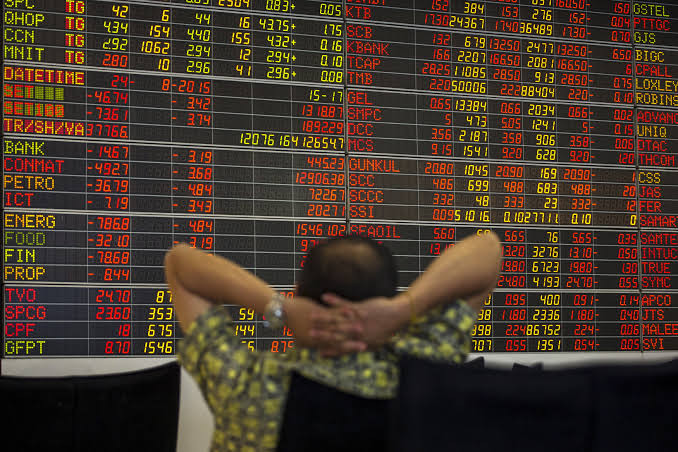
KUALA LUMPUR: Asian equities were expected to open lower today as renewed selling on Wall Street weighed on investor sentiment, with concerns over technology stocks and the returns from artificial intelligence (AI) investments continuing to unsettle markets.
The cautious mood persisted despite Nvidia Corp delivering a stronger-than-expected revenue outlook, offering some reassurance about demand for AI-related chips, reported Bloomberg.
The US chipmaker forecast fourth-quarter fiscal revenue of US$130 billion, plus or minus 3%, exceeding the analyst consensus of US$125.3 billion. Its shares gained about 2% in after-hours trading following the announcement.
However, Nvidia shares had fallen for a fourth consecutive session during regular trading as investors assessed the company's longer-term prospects and leadership uncertainty following the reported departure of chief executive Jensen Huang. Huang has indicated a willingness to return to the role, although the board is not currently considering such a move.
Futures for Australia and Japan pointed to weaker openings, while South Korean futures were little changed.
On Wall Street, the Nasdaq 100 declined 0.7%, while the S&P 500 fell 1%, touching its lowest level since June. Technology stocks faced additional pressure from a series of technical disruptions affecting the US electronic intelligence agency and Apple Inc's services.
Nvidia's earnings outlook has become an important gauge of the strength of AI demand, given its dominant position in supplying chips used to develop and operate AI systems. However, its positive forecast may not be sufficient to ease wider concerns about whether the enormous investments in AI infrastructure will generate adequate returns.
Investor caution was also reflected in a Bank of America survey, which showed fund managers' net overweight positions in technology stocks falling to 12% from 37% in October. The decline was the sharpest since 2006.
Bank of America strategist Michael Hartnett said investors were sending a strong message that companies should reconsider the pace of their AI spending.
Meanwhile, attention was also on the planned initial public offering (IPO) of AI company Anthropic PBC, which is scheduled to price its shares on Nov 18. The company is reportedly guiding prospective investors towards a valuation at the upper end of its indicative range or potentially higher.
Amazon.com Inc and Alphabet Inc's Google are expected to hold nearly 15% and 14% of Anthropic's outstanding shares respectively following the IPO and private placement.
Elsewhere, oil prices traded unevenly as renewed hostilities in the Middle East raised concerns over potential supply disruptions.
Attacks on vessels were reported in and around the Strait of Hormuz, while Iran threatened civilian infrastructure near US or Israeli military bases. A US military official also said American warplanes had struck an Iranian missile launch site on Qeshm Island in the Persian Gulf.
In the bond market, US Treasury yields declined across maturities as investors sought safer assets. However, the 10-year Treasury yield remained above 5%, approaching its longest period at that level in nearly two decades.
Markets were also positioning for further monetary tightening by the Federal Reserve amid persistent inflationary pressures. Traders were fully pricing in a 25-basis-point interest rate increase at the central bank's Dec 9 meeting, with more than 80 basis points of additional tightening expected by September 2027.
Federal Reserve Bank of St Louis president Alberto Musalem indicated support for multiple rate increases, while New York Fed president John Williams said further action was necessary to bring inflation back towards the central bank's target.
Williams said economic data pointed to an economy that remained strong and was strengthening further, while inflation continued to be stubbornly high.
He added that the Fed needed to bring inflation down, although he did not see a need for an unusually large rate increase.